At its most basic, the process of marketing involves turning your suspect pool into profits. At one end of the process are all the potential people who could buy your product; at the other end is your company’s bottom line.
Of course, there are a lot of interim steps along the way. First the suspects are exposed to your marketing efforts. Then perhaps those suspects take an action that turns them into leads. Leads get qualified by sales. Some of those qualified leads become customers. Customers generate revenue, which eventually (hopefully) becomes profits for the organization.
At each of those steps, there are metrics that marketing can track. But in our experience, most B2B marketing teams aren’t going far enough down the line.
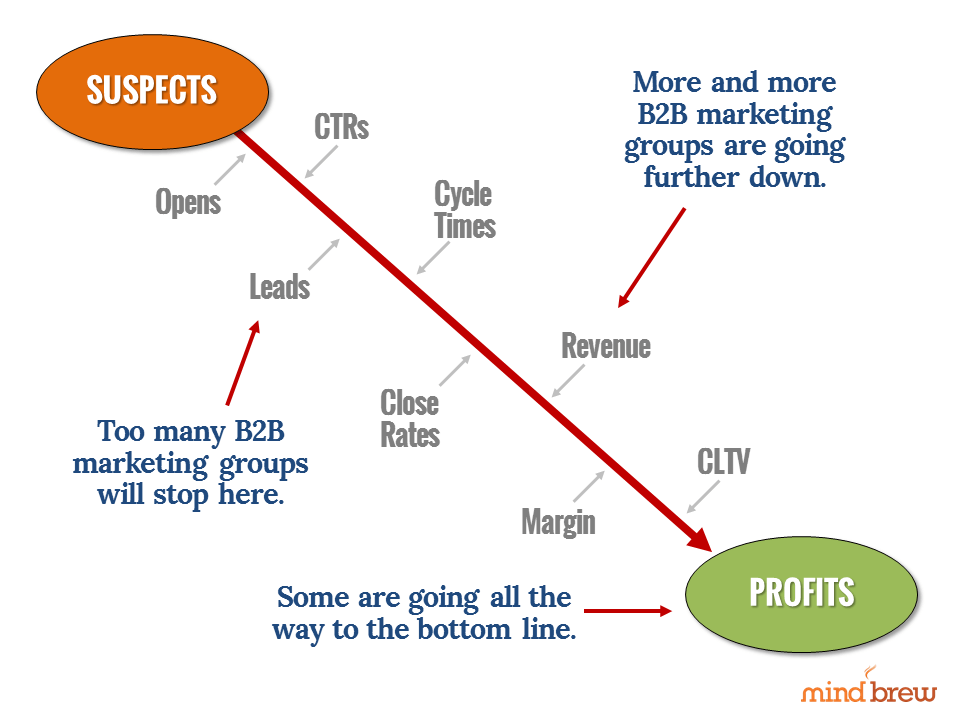
Near the beginning of the marketing process are metrics like opens, click-through rates and leads. Nearly all B2B marketers track these sorts of numbers. They want to know, for example, which channels offer the lowest cost-per-lead so that they can put more dollars towards efforts that generate more leads for the company.
While that seems very reasonable, this sort of myopic focus on leads can lead to some very bad decision-making. What if a particular channel generates a bunch of leads who never buy anything? Or what if it generates leads who only purchase your company’s least profitable products. Suddenly, that low cost-per-lead doesn’t seem nearly as attractive.
These days, a lot of good B2B marketers are going much farther down the line and tracking metrics like cycle times, close rates and revenue. Some marketing groups are actually even being held accountable for generating a certain amount of revenue every month or every quarter.
While this is a step in the right direction, it doesn’t go quite far enough. History is littered with companies that have gone out of business because they generated a lot of revenue without generating any profits for their organizations.
The best B2B marketers go much farther, tracking margins, customer lifetime values and eventually profitability. These marketers are making much better decisions because they are selecting marketing channels based not just on cost-per-lead, but ultimately based on which channel will make their firm more profitable. These marketers are much more valuable to their companies, and in turn, generally experience much greater career success as their companies become more successful as well.
Not tracking the right metrics is just one of the potential minefields that B2B marketers face. For more tips on avoiding costly mistakes, check out the webinar Navigating the B2B Marketing Minefields. It can help you avoid falling for some of the most common myths and misconceptions that plague marketing.
Navigating the B2B Marketing Minefields

There are many myths and misconceptions about B2B marketing that can trip you up, hold you back, and prevent you from achieving success. In this on-demand webinar, you'll learn what they are and how to avoid them.